Akron Tree Service Removal in Green, OH - Costs, Quotes & Local Notes
Taking a tree down is a rigging job, not a saw job, and the quote should show which one you are buying.
A removal quote is built from four numbers: height, trunk diameter at chest height, how far the tree is from anything you cannot replace, and how much room a truck has to work. Two trees of the same size can differ by a factor of three on those numbers alone. This page explains what moves the price in Akron, what a written quote should contain, and where the city permit applies.
| Job | Published 2026 range |
|---|---|
| Above-ground liner, full job | $700 - $2,500 |
| 16 x 32 inground liner | $2,100 - $3,000 |
| 20 x 40 inground liner | $3,000 - $5,500 |
| Refill water | $60 - $350 city, $400 - $900 trucked |
| Wall, floor and gasket repairs | $100 - $3,000 depending on scope |
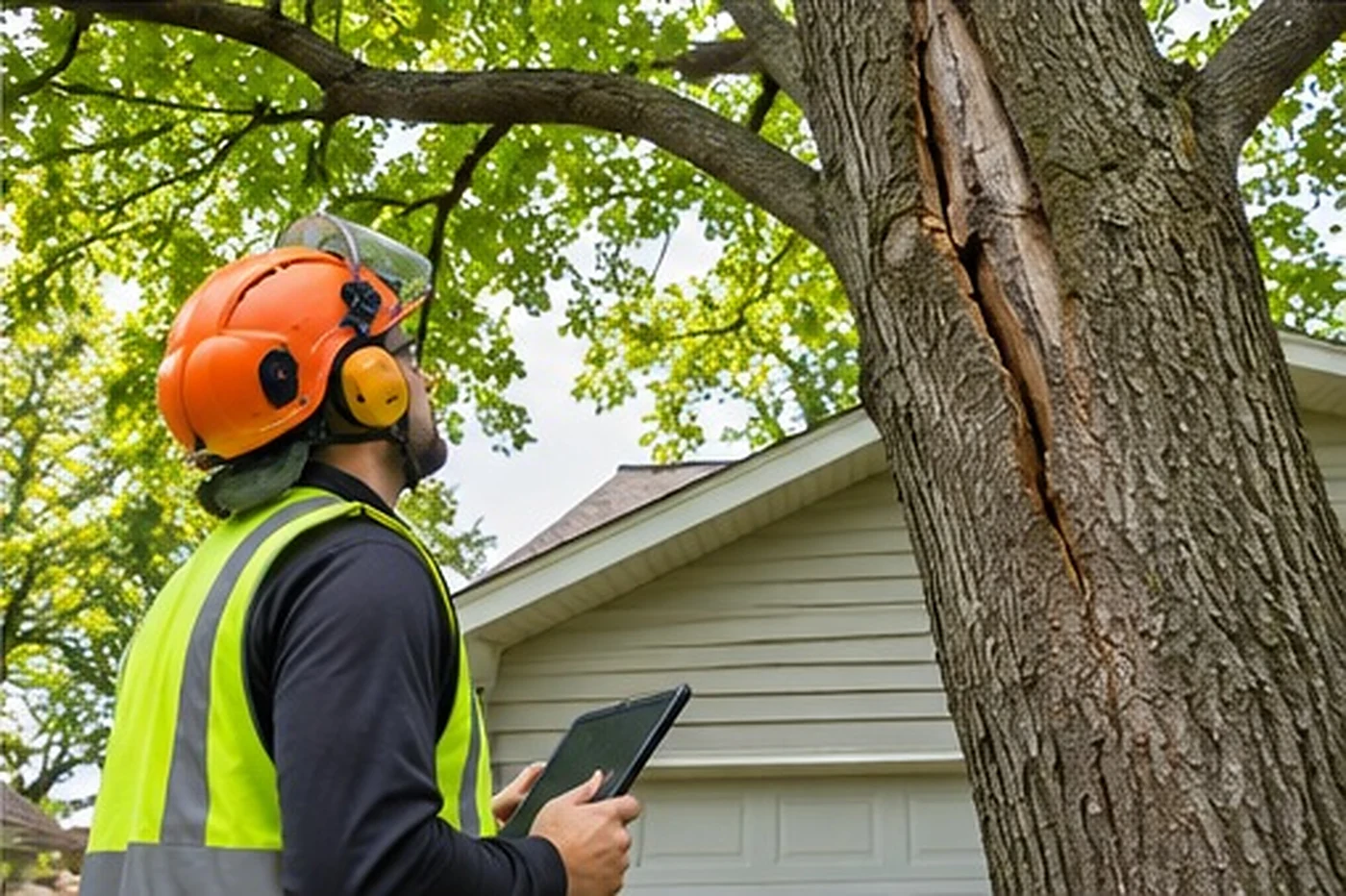
A crew walks up and reads the tree before it names a price. Height decides the equipment: a small tree under 30 ft can usually be felled in a controlled direction, while a 70 ft oak next to a house is worked down in sections and lowered on ropes. Trunk diameter decides how much wood has to be carried out and how long the saws run. Access decides whether a bucket truck can park on the driveway or whether every piece comes off on a rig.
Targets are the third input. A roof, a carport, a fence, a shed, a service drop or a neighbor's garage changes the method from felling to rigging, and rigging is slower. A crane removes the risk of working over a structure but adds a large fixed cost, so it usually only pays on the big removals.
National published ranges in 2026 run from $400 to $1,200 for a typical removal, with an average around $850. Height bands tell you more: under 30 ft $200 to $500, 30 to 60 ft $500 to $1,500, 60 to 80 ft $850 to $2,000, and over 80 ft $1,200 to $2,500 or more. The published floor is about $200 for a small accessible tree and the ceiling reaches $3,000 for a large or complex removal.
Those are national figures from HomeGuide, not Akron figures. Local quotes in Summit County land inside or above them depending on the property: a dense subdivision lot where the truck cannot leave the street sits at the top of a band, while a tree in an open backyard sits at the bottom.
Write the scope down before anyone starts a saw. A complete removal covers the tree, the brush, the hauling, and the cleanup of the work area. The stump is a separate line: a flush cut leaves the stump and the main roots in the ground, and grinding is quoted on its own at $100 to $500 or more per stump.
Rolling till plains that were farmed before they were built on. Newer subdivisions sit on graded and compacted ground, which is why a young tree can go over in a wet spring with its root plate intact.
Municipal water in Green is provided by Aqua Ohio, whose customer service is on 877.987.2782. Sewer, where it exists, is Summit County's: the Department of Sanitary Sewer Services is on 330.926.2400. The city itself is on 330.896.5500. Call 811 before any digging or stump grinding.
Utility accounts: Aqua Ohio (municipal water for the city of Green) · 877-987-2782
Published national ranges run $400 to $1,200 for a typical removal, with an average around $850, and bands by height: under 30 ft $200 to $500, 30 to 60 ft $500 to $1,500, 60 to 80 ft $850 to $2,000, and over 80 ft $1,200 to $2,500 or more. Local quotes move with access, targets under the tree, and how the wood leaves the property.
A permit is needed for a public tree: one along a city street, in a park or on city property. Akron handles those through 311, and the city Tree Commission hears resident complaints about them. A tree on private property does not need the city permit, but confirm where the right of way ends before you assume the tree is yours.
Usually yes. A crew either fells the tree into a clear drop zone or works it down in sections and lowers each piece on a rig. A crane is chosen when the piece weight or the target outweighs the rigging approach, and it adds a fixed cost to the job.